The Lego Masters phenomenon has brought the idea of 100% customised LEGO projects to the attention of a global audience. LM is a reality series in which talented LEGO enthusiasts compete to build the best project, with local versions filming in several countries around the world. In Australia, fans were recently treated to an outstanding “Grand Masters” series (S5, 2023), which saw the return of various former finalists (and some wild-cards) coming back to compete in some of the most challenging scenarios yet. The builds created during this best-of-the-best season were par excellence.

[Images sourced from https://9now.nine.com.au/lego-masters/gallery]
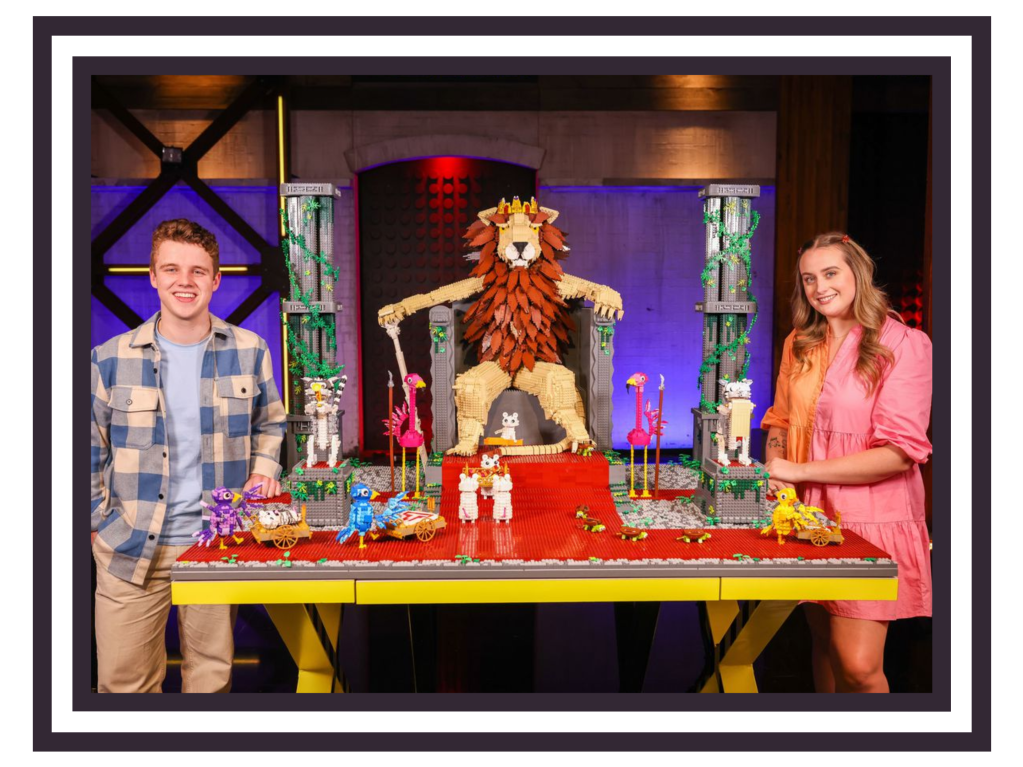
Grand-Master competitor Alex, coming into her first LM season, had described herself as “just a set-builder”. Across two seasons, her growth as a LEGO builder – and that of her partner in (cat)crime, Caleb – was one of the most marked of the series. Like pre-LM Alex, I’m essentially a set builder. However, as I progress further into my LEGO hobby, my imagination has begun to spawn various ideas for My Own Creations (aka. “MOCs”). But materialising these ideas into something tangible – a physical, brick-built model – takes more than just idle daydreaming. Accordingly, my question in this article is this: How does someone evolve from being “just a set-builder”, who has only built from official LEGO instructions, to successfully learning to create their own builds from scratch?
I recently reached out to Alex to ask her this very question and she generously shared some insights from her time on LEGO Masters AU:
“I think that you learn SO many techniques from doing sets, and you really don’t gather how much you really are learning from them until you are put into an environment in which you need to DO it, or go home. LEGO is just a particular medium of art, over time you just get used to using that medium. You learn different pieces and connections. You have amazing team mates that help you with things you get stuck on.”
[Image sourced from https://9now.nine.com.au/lego-masters/gallery]
Over two blog posts, we explore some ideas that can help a set builder along the path to becoming a MOC builder. “PART 1: The Play Paradigm” focuses on builder mindset, and “PART 2: Pathways & Barriers” surveys the tactics and issues of becoming a MOC builder. In its entirety, this article provides a conceptual framework in which to embed your own personal MOC journey. As we’ll discover, Alex’s advice is on point – playing around with set building unquestionably lays the foundation for using LEGO bricks and parts as a creative medium for making artwork. And, reaching out to others for help when you need it, is entirely consistent with the LEGO Brand Framework. So, read on to delve deeper into the transformation from LEGO Set Builder to LEGO MOC Creator.
PART 2: Pathways & Barriers
Previously, we explored the role of a playful mindset as prerequisite for successful creative play with LEGO bricks. Now, we survey what the technical process is to become a MOC builder, along with particular challenges faced by adult fans of LEGO (AFOLs). As a set builder myself, aspiring to incorporate MOCs into my creative repertoire, I researched what advice experienced MOC builders were already sharing. The guidance imparted by these building veterans followed a consistent pattern, which I’ve generalised in the graphic below.

Experienced MOC creators caution that a builder’s initial attempts of “moccing” may yield a mediocre outcome – at best! Hence, the experts emphasise the importance of continuing to practice and learn – from both your own experience and research, as well as reaching out to others in the MOC community for additional support. There are numerous blogs and vlogs sharing what other creators have made and how they’ve achieved it; these are valuable sources of inspiration and education.
Furthermore, like any creative pursuit, there is no one, single correct method for creating a MOC. Ideas for models can be inspired by observations of real life, drawn from the imagination, or based on a personal interest, and so on. Also, it’s a matter of personal preference whether to adopt a formal planning process or to improvise as the building progresses. There are, however, at least a few basic factors that are useful to consider prior to commencing construction to help produce the best outcome.
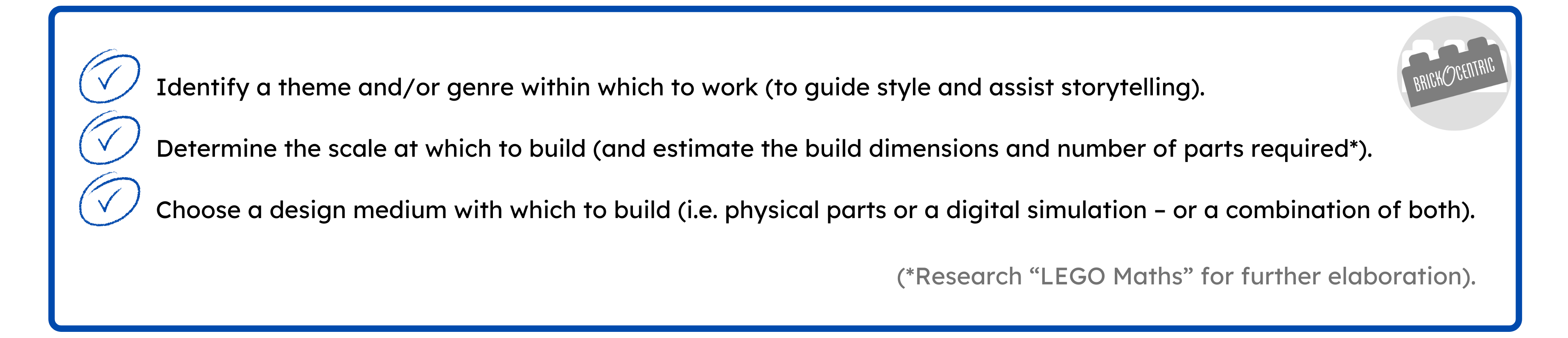
Some hobbyists prefer to build from a stash of real bricks that can be manipulated and experimented with in a tactile mode. Others prefer to use virtual design software for its efficiency of storage space, parts diversity, and build cost (i.e. unlimited, free bricks). Studio, for example, is freely available for download at Bricklink.com for creating digital builds and generating matching building instructions. The program integrates with the Bricklink database to help users source and order a tailored inventory of required parts (from which to recreate a physical, brick-build version of the MOC – if desired).
Not all AFOLs choose to MOC though. Last year (November, 2022), Huw Millington (@Huw of Brickset.com) polled the Brickset community about their LEGO collection habits. The results revealed that most of the respondents preferred to build and display their official sets in their original form (or with only minimal changes, if any). The builds were then exhibited either indefinitely (the favourite/s) or on rotation (the bulk of the collection) – before (eventually) being packed away separately again. The survey indicated that members of this particular fan community were therefore not especially disposed to requisitioning the parts of their (inviolable) LEGO sets to build their own models with. A second, follow-up poll was then presented, this time asking its audience explicitly whether or not they design and build their own creations, and if not, then for what reason/s?
The responses confirmed that many of these particular LEGO enthusiasts did not build MOCs but that they did, however, often enjoy modifying their official sets. “Mods” – the name given to existing sets that have been modified – are considered more achievable than MOCs, because they require less know-how, effort and time, and fewer new parts. Additionally, some builders also reported enjoying building other people’s MOCs (despite not making their own ones) – embracing novelty, without an extraneous cognitive load or the need for any particular expertise (e.g. in design skills or parts knowledge). Finally, despite not presently engaged with MOC building, some enthusiasts nonetheless hoped to do so in future (in anticipation of more favourable circumstances).
Common barriers to “moccing” (in the present) that were widely reported in this poll, included the following:
- perceiving oneself as “not creative enough” or “not skilled enough”
- a “collector’s mindset” of not wanting to indiscriminately mix the parts of different sets together
- problems organising and managing a collection to be able to find particular part conveniently (or at all!)*
- the challenge of “real-life constraints” – i.e. not having enough time, space or inventory to effectively work with (or the money to acquire more parts with)
(*See my previous post “Brickogistics” for some useful insights into LEGO logistics).
Some LEGO enthusiasts who had intentionally chosen not to MOC simply valued their official sets as they were (or at least their main model) and enjoyed showcasing their prized collection. For instance, @NCpants (United States) stated: “I’m simply not interested in MOCs. I enjoy building LEGO sets, displaying them, and then I take them apart and put them away. I take them back out and rebuild them as I feel so moved.” Another reason presented, was to outsource the arduous, higher-order thinking (of creative endeavour) to the LEGO designers in Billund, in order to liberate individual builders’ minds for a relaxing (even meditative-like) experience for themselves. For example, @Dynnus (United Kingdom) specified: “I use Lego to help unwind and settle my brain. Following instructions helps. Being creative and making my own things would counter that process.”
Alternatively, those builders who enjoyed modding, were driven by an entirely different motivation – substituting relaxation for stimulation. For instance, @Spritetoggle (United States) enthused: “Almost every set I purchase is bought with the intent of modifying it into something unique for my needs/wants. My creativity works best with a pre-existing framework […] If you’re not at least tweaking a LEGO set to suit your tastes, I kind of feel you’re doing it wrong.” Modding was also perceived as a potential gateway to eventually moccing (for those pursuing that path) or a worthwhile alternative to it (for those who were not). A modding advocate, @ComfySofa (United Kingdom), encouraged others: “I can highly recommend giving this kind of thing a go, especially to those of us who don’t feel very creative or might feel they don’t have the design or construction skills to build from scratch […] It’s challenging, but without the sometimes-daunting prospect of starting with a completely blank canvas.”
For actual MOC builders, their motivation seemed underpinned by a passion for imaginative “play” – the heart and soul of the LEGO brand’s philosophy. MOC builder @GregoryBrick (Canada) explained: “I see LEGO bricks and all I want to do is take them apart and build something new […] Build it, play with it, take a picture, and dismantle it so I can start on the next creation […] I never felt I needed a large selection of elements to make MOCs. Don’t have enough of a certain brick? Build the thing another way, or build another thing. More elements is always nice, but never has it been necessary.” Similarly, @PurpleDave (United States) stressed that: “If you look at the history of the company, the “intended purpose” was always for kids to build from their imagination. Formal sets with printed instructions came much later, as a way to drive sales, so [if not moccing] you’re actually limiting your use to their secondary purpose.”
Nonetheless, open-ended building eluded many older LEGO fans. For example, @MartyMcFly (United Kingdom) shared an all-too-familiar obstacle for grownup builders: “I used to build my own creations when I was younger […] I just don’t have the imagination to build like I used to.” And, echoing another common problem, @Ravastia (Netherlands) conceded: “I have so many ideas I’d love to build, and I create occasionally, but don’t have the skills yet to realise the ideas in my head.” However, self-assessments of creativity and skill are (mostly) subjective, and consequently are vulnerable to unrealistic standards – and comparing poorly to others can discourage activity that might otherwise be enjoyed. Congruently, @bananaworld (United Kingdom) reflected: “I’m not sure if seeing [other people’s MOCs] hinders or helps me; on one hand, they can be inspiring, but on the other […] they illicit a reaction something like: “I could never make anything that good, so why bother trying?”.”
Alternatively, some builders seemed perfectly tolerant of their limitations and engaged in creative activity, regardless. For example, @Desbug (United Kingdom) acknowledged: “Lego in our household is really a joint activity between generations. So lots of home creations get built but they are not necessarily very aesthetic.” Here, the focus is on the members of the family valuing their shared experience (rightly so) – playing together through the medium of LEGO storytelling, unconcerned about outside judgement. Another comment, by @PhantomBricks (United States), reflected a growth-focused mindset: “I began approaching MOCs as an adult fairly recently […] I find that the Minifigures are what gives me inspiration for a build.” The builder elaborated on their (thus far) limited output and their plans for future focus. In having identified their inspiration, any current limitations the builder was experiencing did not inhibit their aspiration to grow creatively.

[Images sourced from brickset.com]
The final words of wisdom come from a contributor of the Bricklink poll who imparted this constructive perspective: “When we enter this world, none of us has ever heard of, seen, or touched LEGO bricks, and we certainly have no idea how to make something that could qualify as “art” out of them. Stepping back because you don’t feel like you’re good at it is the surest way to keep yourself from being good at it” – @PurpleDave (United States). In other words, a closed mind (i.e. a fixed mindset) disables a LEGO builder from achieving their potential. Instead, playful learning must be embraced, where risks are taken, failures are learned from, and optimism in the future is sustained. The aspiring MOC builder must be prepared to put in the work – i.e. developing and expanding their technical knowledge, experimenting with style, practicing storytelling, and finding their inspiration/s. Indeed, the journey from set builder to MOC creator exemplifies the philosophy of “learning through play”, and any person – at any age – can embrace its power of transformation.
Over the last two blog posts, my investigation into free-building with LEGO bricks and parts has raised my awareness of the behavioural and attitudinal factors that can either assist or defeat a LEGO hobbyist on the path from Set Builder to MOC Creator. I hope that you have also found value in the ideas and information presented herein. If you’d like to keep the conversation going, please comment below whether YOU are a set builder, MOC builder, or BOTH – and what inspires and/or deters YOU from following your preferred building path. And, whatever our path, may we all “play well”.
“Lego is fun; it’s therapeutic. It’s a beautiful sensation when you click the pieces together.” – James May
“With a bucket of Lego, you can tell any story. You can build (…) whatever you can imagine.” – Christopher Miller
 BRICKOCENTRIC