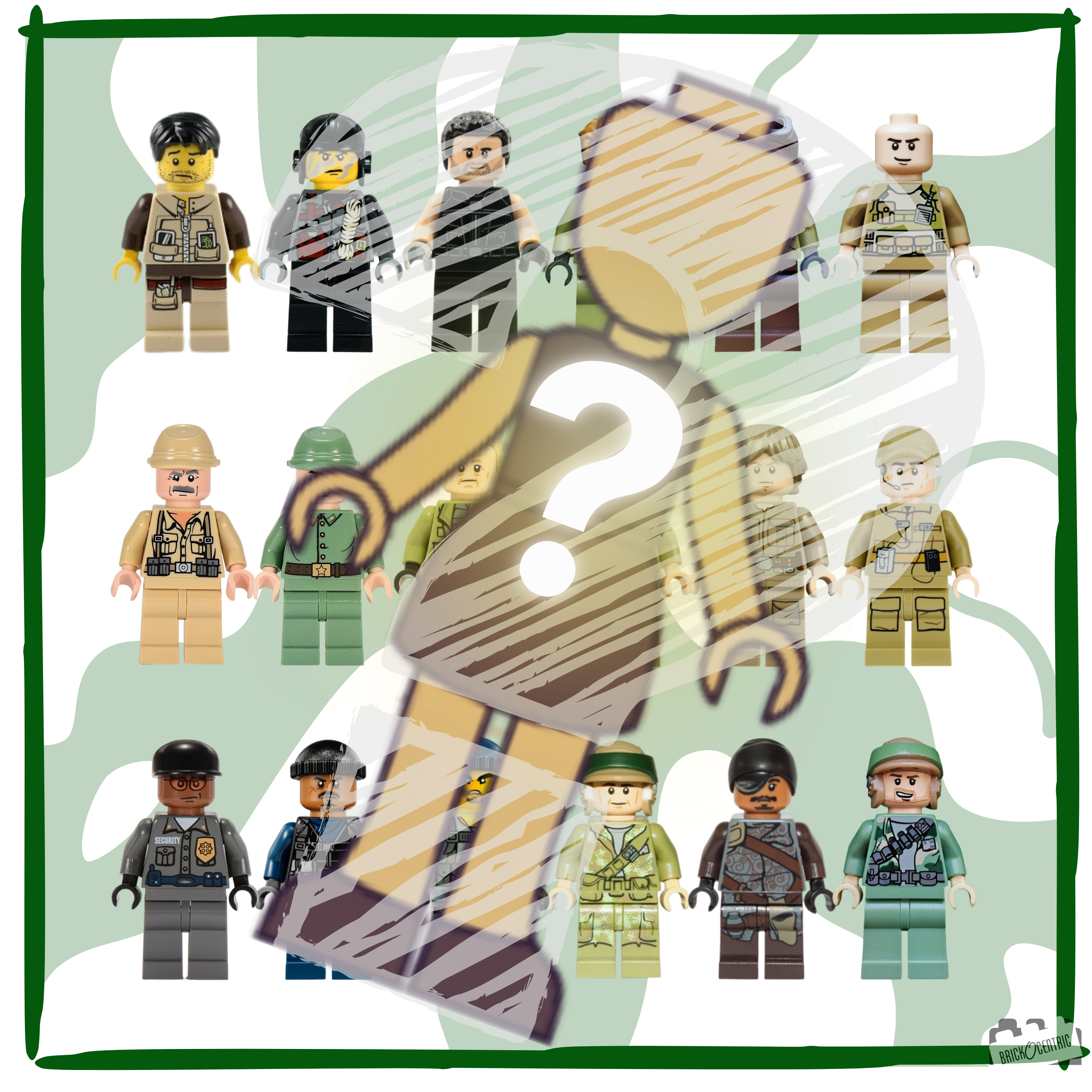
[Character images sourced from Brickset.com & picture edited by Brickocentric.com]
Welcome back to my BrickoBlog. When I began writing about my “Minidoll Militia” MOC project in my previous post, the current war between Israel and Hamas had not yet broken out. Since then, these unfolding events, compounded with the ongoing war between Russia and Ukraine (as well as any other of the violent conflicts around the world), mean that various individuals in our communities are experiencing significant difficulty in managing a healthy headspace at the present time. In this context, I acknowledge that some people might not appreciate content containing military themes (and hence my disclaimer at the beginning of this post and my previous one).
This realisation prompted me to think about the role of weapons, war, conflict and violence in recreational experiences, including LEGO activity. Needless to say, the realistic destruction of human life is not a matter for casual play (particularly for minors, who are still actively shaping their moral identity and world view). So foremost, I want to clarify that my reference to “wargaming” in the previous article was not a commentary on, nor a glorification of, real-world current affairs. The Minidoll Militia project is purely a product of fantasy, on behalf of an individual who appreciates the strategic competition element of table-top wargaming, as well as the aesthetically interesting figures and historical eras represented therein.
In the case of LEGO experiences (and other storytelling media), setting up “Goodies” vs. “Baddies” scenarios is an age-old staple of storytelling. Importantly, this play theme enables children to constructively experiment with the nature of conflict and resolution in an imaginary setting, with characters they are able to identify as make-believe. Obviously, age-appropriate boundaries around the expression of violence in such play ought to be sensitively managed by a mature caretaker/guardian as part of their duty of care to the child. Knowing the child – i.e. understanding their emotional maturity, sensitivities, interests and fears – is key in supporting healthy, play-based learning in the young person, particularly when dealing with a sensitive subject like violence.
Education research verifies that children experience powerful learning when they are given targeted and timely feedback. So, in the above said “Goodies vs. Baddies” storyline play, this requires that the adult intentionally integrates appropriate and informative ideas into the child-directed roleplay, encouraging dialogue during the course of play to prompt critical and reflective thinking in the child. Whilst somewhat academic, essentially this means that a parent (for example), in engaging with their child’s imaginary world of play, can use this natural interaction as a vehicle for teaching the child important life lessons about themselves, other people, and the wider world.
Thus, handled correctly, this type of play (LEGO based or otherwise) is in no way equivalent to normalising, endorsing, or celebrating real-world violence. On the contrary, it may, in fact, serve to build subject matter awareness and personal values in the child that actually protect them against adopting violent attitudes and behaviours. However, in reality, not all children have access to good quality parenting. In those cases, the child is at risk of learning harmful or dangerous lessons from un/mis-informed, unsupervised play experiences based on violence. Thus, ethically, vulnerable children need to be respected by brands who market to children, to protect them from potential psychological maldevelopment.

Nowadays, The LEGO Group (TLG) enjoys a growing adult market, but its primary audience has, of course, traditionally been children. Prudently, the TLG’s philosophies are child-focused and intentionally align with respecting and promoting healthy childhood development and learning. In reports published in 2010–2011, TLG officially recognised the brand’s (previously unwritten) guidelines for the proper inclusion and representation of weapons and violence in their products. Today, LEGO products, communications, representatives and other affiliates, are expected to adhere to the strict rules established to maintain the ethical reputation of the LEGO brand, and to support the UNICEF-mandated protection of a safe childhood.
One of the TLG reports affirmed that: “Learning about how to handle conflicts, aggression and weapons is often part of a LEGO play experience, but only as a means to achieve the goal, whether it is rescuing citizens, finding treasure or saving the universe […] The LEGO play experience must never be related to real world modern warfare, killing, torture or cruelty to animals” (TLG, 2011). Another of the reports similarly specified that: “The basic aim is to avoid realistic weapons and military equipment that children may recognize from hot spots around the world and to refrain from showing violent or frightening situations […] The purpose is for the LEGO brand not to be associated with issues that glorify conflicts and unethical or harmful behavior.” (TLG, 2010).
In conclusion, we can surmise that themes of weapons, war, conflict and violence are regarded by psychologists as a relatively normal part of childhood play and development, which can yield positive benefits to the child’s moral learning. However, responsible boundaries must be in place to protect vulnerable children from the potentially harmful impact of excessive, extreme, and uninformed forms of this kind of play. In this regard, TLG’s commitment to providing only limited, “child-appropriate”, fantasy-based representations of fighting and weaponry – likely at the expense of their bottom line – is an ethically commendable and socially responsible decision.
Question: What’s your assessment of this issue? Is the intensity and type of conflict or violence featured in modern LEGO sets appropriate for younger builders, or are the products either too gratuitous or too restricted in their current depictions?
 BRICKOCENTRIC